 Italiano
 English
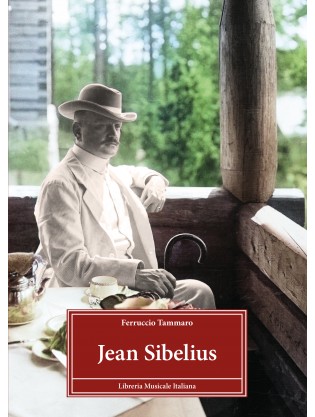 View larger

Jean Sibelius
| Author | Ferruccio Tammaro |
| Series | Profili |
| Nr. | 5 |
| Size | 17×24, pp. XIV+836 |
| Year | 2023 |
| ISBN | 9788855431897 |
Sibelius left us a legacy that still challenges the listener today. Often confined, mainly due to such excellent works as The Swan of Tuonela and Valse triste, to cynere boreal atmospheres, he was in fact, if one broadens the view to his entire varied production, an artist always animated by a clear and strong inner temperament that did not remain confined to the optimistic "resurgent" momentum experienced by his Finland at the time, but always stretched out to invest in a moral sense 'man'. And in old age, having seen his nation finally become a true independent nation, always in the name of this vitalistic limpidity he decided to isolate himself progressively so as not to have to breathe in the malevolent fog that was then poisoning much of the European continent.
Sibelius succeeded in positioning himself as a national musician without resorting to the dialect of folk songs and dances at home; at the same time he came to establish himself as an international figure by adopting a particular style that distanced him from any homogenized musical language. A style that, as Carl Dahlhaus has well noted, cannot be received only as the result of late Romantic waste. Sibelius after all has never lain in the cone of shadow of colleagues more famous than himself and has been able to create works that shine in their own light and are completely insensitive to the allure of fashions and the trawling of clichés.
It is the exclusive relationship he established with nature, ideally traversed by the flight of those migratory birds in which he felt encapsulated a true "nostalgia for the sky": that is, an expression of a genuine simplicity as much of thought as of construction, which infiltrated his music with lifeblood and energy of spirit. Far from believing that only that which is complicated can be profound, Sibelius appealed to a nature that, moving from that of his land, expanded to the nature of everywhere and established itself as the architectural principle and existential archetype of man gathered within himself. So a nature to be understood not in an illustrative or physiological way, but as an expression of spiritual life, as an Edenic world, as a means of abstraction, of suspension from time, of immersion in an inner reality in which past, present and future are one.
Translated with www.DeepL.com/Translator