 Italiano
 English

 View larger
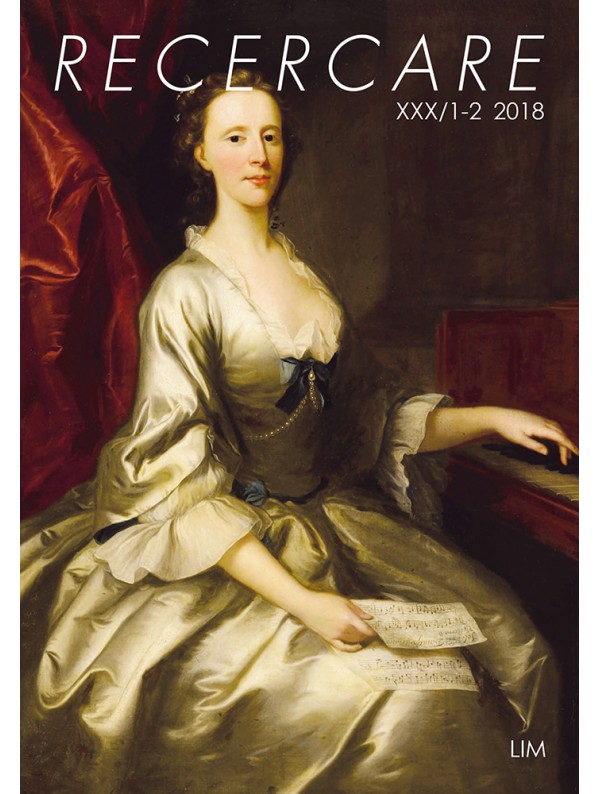
All’ombra di una corte. Lucia Coppa, allieva di Frescobaldi e virtuosa del marchese Filippo Niccolini
| Author | Antonella D'Ovidio |
| Series | Recercare - Rivista per lo studio e la pratica della musica antica - Journal for the study and practice of early music |
| Nr. | XXX/1-2 2018 |
| Size | 17×24, pp. 250 (63-93) |
| Year | 2018 |
| ISBN | 9788870969900 |
Far from the spotlight of operatic performances and the worldly chronicles of the time, the history of those virtuose di musica, who in the seventeenth century lived their lives in the service of aristocratic families, usually leaves little trace in the archival documents, which only rarely allow us to illuminate vividly their profiles or to reconstruct their careers. On the basis of unpublished documents from the private archive of the Niccolini di Camugliano family (mostly inventories and account books) and recent studies on the musical patronage of Florentine patricians in the seventeenth century, the article focuses on the life and career of the singer and harpsichordist Lucia Coppa Rivani (1625–1699). Although initially protected by Giovan Carlo de’ Medici, Lucia, the sister-in-law of the famous castrato Antonio Rivani, spent most of her life in the service of the Florentine marquis Filippo Niccolini, becoming the leading singer in his private court. The nobleman took care of the training of the young Lucia (with Girolamo Frescobaldi and Filippo Vitali) and facilitated her career, also ensuring her, through donations of goods and valuable musical instruments, a considerable social and economic status. In a broader perspective, the reconstruction of Lucia Coppa’s life allows us to observe the training and career paths of a singer in the service of an aristocratic family in seventeenth-century Florence and the decisive role that educated members of the Florentine nobility could play in this. At the same time, her biography also sheds new light on Filippo Niccolini’s musical patronage, particularly on the network of his relationships within the Roman and Florentine musical environment, on musical performances that took place in his residences, and on his musical taste in relation to the Medici’s, confirming his importance in the Florentine musical scene in the second half of the seventeenth century.
Antonella D’Ovidio is lecturer in Musicology at the University of Florence. She completed her Ph.D. in Musicology at the University of Pavia-Cremona in 2004. In 2006 she received a post-doctoral fellowship from the Accademia Nazionale dei Lincei (Rome); from 2008 to 2015 she was a research fellow at the Universities of Siena and Florence. Her research interests include Italian instrumental music of the seventeenth and eighteenth centuries; musical patronage in seventeenth-century Florence; eighteenth-century Italian opera; and Italian music criticism in the nineteenth century. She has published articles in international musicological journals, as well as a critical edition of Didone abbandonata (1747) by Niccolò Jommelli (2015). She co-edited the volume Arcangelo Corelli tra mito e realtà storica (2007). In 2018 she obtained the Albi Rosenthal Visiting Fellowship in Music at the Bodleian Library of Oxford for her research project Manuscript Sources of Roman Trio Sonata in the Bodleian Library: The Works of Lelio Colista (1629-1680) and its Transmission and Assimilation in England.
antonella.dovidio@unifi.it
Reduced PDF